
 The idea of having a therapist come into your home can bring up a lot of feelings at once. Maybe relief that you won’t be loading your child into the car for clinic visits. Maybe a little nervousness about what it’ll actually be like — Where will they work? What do I need to do? Do I have to tidy the whole house first?
Those questions are completely normal, and they all have simple answers. This guide walks you through what in-home ABA therapy really looks like, from the first visit to a typical session, so you can picture it clearly and decide what’s right for your family.
In-home ABA is exactly what it sounds like: Applied Behavior Analysis therapy delivered in your home rather than at a center. A trained therapist works one-on-one with your child, following a plan designed and overseen by a Board Certified Behavior Analyst (BCBA).
The therapy itself is the same evidence-based approach used anywhere — breaking skills into small, encouraging steps and building them up over time. What changes is the setting. Instead of practicing in an unfamiliar clinic, your child learns in the place they already live, play, and grow.
That matters for a practical reason: the goal of ABA is for skills to show up in real life. When a child practices asking for a snack in their own kitchen, builds a daily routine like getting dressed, or works through a big feeling in their own living room, they’re learning right where those skills will be used — at home, at school, and out in the community.
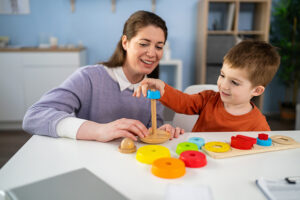
What a session looks like depends on your child — their age, their goals, and their needs. For many younger children, an in-home session can look a lot like play, because play is how they learn best. For older children, sessions may include more structured practice — working on routines, daily-living skills, or school-readiness activities right where they’ll be used.
A typical visit might include:
The ABA we provide is child-led and assent-based: our approach centers your child’s comfort and is built around their cues, with breaks woven into how sessions are designed. A comfortable child is a child who’s ready to learn.
This is one of the most common worries, so let’s put it to rest: no, you don’t need to clean the whole house or buy anything special.
What helps is simple:
Your therapist will make the most of the space you have. Real homes are exactly the point — your child is supposed to learn in a real, lived-in environment, not a staged one.
And if you have other children at home, that’s perfectly fine. Siblings don’t need to stay out of sight during sessions — sometimes they can even join in, since sharing and playing with a brother or sister is real-life practice at its best.
You’re an important part of the process, but in-home ABA is designed to support you, not to pile more onto your plate.
In practice, that usually means staying nearby when you can, sharing what you’re seeing at home, and learning a few simple strategies you can use in everyday moments — like how to encourage a new word or respond to a tough behavior. These small, consistent habits help your child’s progress carry over into the rest of the week.
And if some weeks are busier than others, that’s okay. We meet families where they are. We also offer bilingual support in English and Spanish, so the people caring for your child can take part in the language they’re most comfortable with.
There’s no single “best” setting — both can work well, and the right fit depends on your child and your situation.
In-home ABA tends to suit families who value:
Clinic-based ABA can be a better fit when a family values:
Some families even find a mix works best over time. The most important thing is choosing what helps your child feel secure and supported — and that’s a conversation worth having with a BCBA who can look at your child’s specific needs.
In-home ABA can help across a wide span of ages — we work with children and teens ages 18 months to 18 years old. So whether you’re worried your child is “too young” or “too old,” the short answer is that many ages fit here.
That said, starting early carries real benefits when it’s possible. The toddler and preschool years are a period of rapid learning, and beginning support then — what’s often called early intervention — can help skills take root in a child’s daily routines. If your child is older, that’s okay too: real progress is possible at any age, and a BCBA can help you sort out what fits your child best right now.
The honest answer is that it depends on your child. There’s no one-size-fits-all schedule.
After an assessment, your BCBA recommends a level of care based on what’s clinically appropriate and considered medically necessary for your child’s specific needs and goals. Some children do well with a focused, lower-hour plan; others benefit from a more intensive schedule.
It depends on your plan. Maryland law includes an autism coverage mandate, and Maryland Medicaid has provisions for ABA when specific eligibility criteria are met. But the only way to know your coverage is to check your benefits – which is why benefits verification is part of our intake process.
Beginning in-home ABA is more straightforward than it may feel right now:
There’s no commitment in simply asking questions. A short conversation can give you a much clearer sense of whether in-home ABA is a good fit.
Arluna ABA was founded by a BCBA with more than a decade of experience supporting children on the spectrum, on a simple belief: families deserve care that is both clinically excellent and genuinely within reach. Those two commitments shape everything we do — and in-home therapy is one of the clearest places you can see them: strong, individualized clinical care, delivered right where your family already is.
For families across the Maryland communities we serve, that means care built around your child’s whole world: their strengths, their routines, and the people who love them. The goal isn’t progress that lives inside a session. It’s growth that shows up at the dinner table, on the playground, and in the ordinary moments of your day. Whenever you’re ready, we’d love to meet your family — and help those moments add up.
Curious whether in-home ABA could be a good fit for your child? Reach out to Arluna ABA for a friendly, no-pressure conversation. We’ll answer your questions, check your insurance benefits, and help you find the right next step for your family.
We are accepting new clients! Complete our secure, HIPAA-compliant intake form to tell us about your child’s needs. Our intake team will review your information and reach out to discuss how therapy can support your child’s development.